Why Intense Morning Empty Stomach Workout May Not Suit Every Woman
Morning workouts are popular because they can help build a consistent exercise routine. Some people also believe that exercising on an empty stomach immediately after waking up burns more fat and produces faster weight loss.
But is intense exercise without breakfast suitable for every woman?
Not necessarily.
Fasted exercise can change how the body uses fuel during a workout, but that does not automatically mean it is better for weight loss or health. Research shows that eating before exercise can improve performance during longer-duration exercise, while fasted exercise may increase hunger or reduce performance in some situations.
For women who are doing high-intensity workouts, long cardio sessions, heavy strength training, or exercising while already under-fueled, having some nutrition before exercise may be more appropriate.
The right approach depends on your workout intensity, health, goals, eating pattern and individual response.
What Does “Empty-Stomach Workout” Mean?
An empty-stomach or fasted workout generally means exercising after several hours without food, often after an overnight fast.
For example:
Dinner at 8:00 PM → Sleep → Wake at 6:00 AM → Intense workout at 6:30 AM → Breakfast afterward
During this period, the body has not received food for several hours.
Light activity such as walking may be comfortable for many people in this state.
The situation can be different when you perform high-intensity exercise.
Does Fasted Exercise Burn More Fat?
This is one of the biggest reasons people choose fasted workouts.
During exercise after an overnight fast, the body can increase the use of fat as a fuel source under certain conditions. Studies in women have demonstrated increased fat oxidation during exercise performed before breakfast.
However:
More fat burned during one workout does not automatically mean more body-fat loss over time.
Long-term weight management depends on overall energy intake, physical activity, nutrition, sleep and many other factors.
A recent systematic review also found that fasted exercise does not necessarily produce better acute metabolic outcomes than fed exercise.
So, “I burn more fat during fasted exercise” does not necessarily mean “I will lose more body fat.”
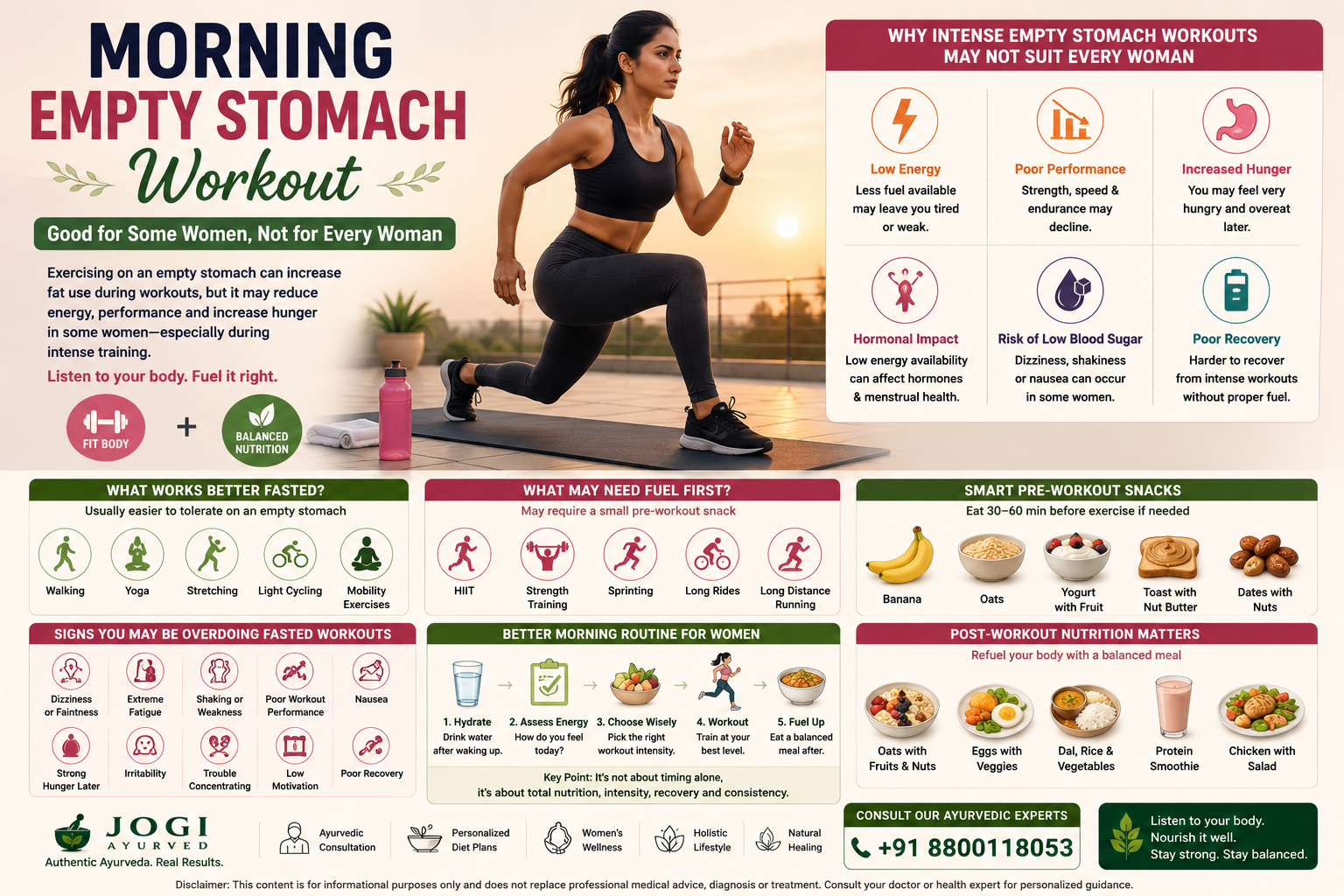
Why Intense Fasted Workouts May Be Difficult for Some Women
1. You May Feel Low on Energy
After an overnight fast, your available food-derived energy is lower.
If you immediately perform:
- HIIT
- Sprinting
- Heavy strength training
- Long-distance running
- High-intensity cycling
- Intense circuit training
you may feel that your workout is harder than usual.
Some research comparing fasted and fed exercise has found advantages for performance when food is consumed before longer-duration exercise.
2. Workout Performance May Drop
The goal of exercise is not simply to burn calories.
For strength and fitness, you also want to train effectively.
If you regularly feel weak or unable to complete your workout after fasting, your training quality may suffer.
A randomized study involving healthy men and women found that fasting before exercise reduced performance, motivation and perceived energy compared with exercising after a meal.
This doesn’t mean every person will perform worse while fasted.
It means that individual responses vary.
3. You May Feel Hungrier Later
An empty-stomach workout may affect appetite differently from person to person.
Some people feel less hungry afterward, while others experience strong hunger.
A systematic review found that fasted exercise could increase subjective hunger in some experimental conditions.
This can become problematic if intense exercise is followed by:
Extreme hunger → overeating → guilt → further restriction
Instead of focusing only on burning calories, focus on maintaining a sustainable eating and exercise routine.
4. Very Low Energy Availability Can Become a Concern
Exercise requires energy.
Your body also needs energy for:
- Brain function
- Heart function
- Hormonal processes
- Reproductive function
- Maintaining muscle
- Immune function
- Recovery
If someone combines very restrictive eating + frequent intense exercise + inadequate recovery, overall energy availability may become too low.
This is different from simply exercising before breakfast once in a while.
For women who frequently train hard while also restricting calories, professional nutritional guidance may be particularly important.
5. Your Menstrual Cycle May Matter
Women’s nutritional and exercise needs can vary across the menstrual cycle, although individual responses are highly variable.
Some women notice changes in:
- Energy
- Appetite
- Sleep
- Exercise tolerance
- Recovery
- Mood
around different phases of their cycle.
This doesn’t mean that every woman needs a completely different workout plan for each menstrual phase.
Instead, pay attention to your individual symptoms and performance.
If you notice that intense fasted workouts consistently make you unusually exhausted, dizzy, or unable to perform—especially around menstruation—consider adjusting your nutrition or workout intensity.
6. It May Not Be Appropriate During Pregnancy
Pregnancy is not the time to experiment with aggressive calorie restriction or intense fasted training without professional guidance.
Exercise during pregnancy can be beneficial for many women, but the appropriate type and intensity depend on the individual pregnancy.
If you are pregnant, consult your obstetrician or healthcare professional before beginning or significantly increasing an intense workout routine.
7. Women With Certain Health Conditions Need Extra Care
Fasted intense exercise may require additional caution if you have:
- Diabetes
- Low blood pressure
- A history of fainting
- Anaemia
- Eating disorders
- Very low body weight
- Certain hormonal conditions
- Pregnancy
- Chronic medical conditions
If you take medicines that affect blood glucose or blood pressure, ask your healthcare professional whether exercising while fasting is appropriate.
Empty-Stomach Exercise Does Not Mean No Exercise
It is important not to misunderstand this topic.
Exercising before breakfast is not automatically unhealthy.
Many healthy people can comfortably perform low- or moderate-intensity morning exercise without eating first.
For example:
Usually Easier to Tolerate Fasted
- Gentle walking
- Light stretching
- Easy yoga
- Mobility exercises
- Low-intensity cycling
May Require More Fuel
- HIIT
- Heavy strength training
- Sprint workouts
- Long runs
- High-intensity cycling
- Long circuit sessions
Your individual response matters more than a rigid rule.
What Should You Eat Before a Morning Workout?
If you find that fasted exercise leaves you weak or your workout quality suffers, try a small pre-workout snack.
Options may include:
- Banana
- Small bowl of oats
- Fruit with yogurt
- Toast with a small amount of nut butter
- A small smoothie
- Dates with a suitable protein source
The amount depends on the workout, your digestion, your goals and how much time you have before exercising.
You don’t necessarily need a large breakfast before training.
How Long Before Exercise Should You Eat?
There is no single timing that works for everyone.
Some people feel comfortable eating 30–60 minutes before exercise, while others prefer more time.
Start with a small, easy-to-digest meal or snack and see how your body responds.
If you experience:
- Bloating
- Nausea
- Stomach cramps
- Reflux
you may need to change the amount, food choice or timing.
What About Water Before a Morning Workout?
Even if you don’t eat before exercise, hydration still matters.
After sleeping overnight, you may wake up needing fluids.
Drink water according to your thirst and individual needs.
For longer or very sweaty workouts, fluid and electrolyte requirements may be greater.
What Should You Eat After a Morning Workout?
Post-workout nutrition helps support recovery.
A balanced meal can include:
Protein
- Eggs
- Yogurt
- Paneer
- Tofu
- Dal
- Beans
- Fish
- Chicken
Carbohydrates
- Oats
- Fruit
- Whole-grain bread
- Roti
- Rice
- Potatoes
Healthy Fats
- Nuts
- Seeds
- Nut butter
- Appropriate plant oils
A simple example:
Oats + yogurt + fruit + nuts
or
Eggs + whole-grain toast + vegetables + fruit
Should Women Stop Fasted Workouts Completely?
No.
There is no need for every woman to stop exercising before breakfast.
The better question is:
“Does this workout style work well for my body, health and goals?”
If you feel energetic, perform well, recover properly and eat adequately throughout the day, a morning workout before breakfast may be comfortable for you.
If you repeatedly experience poor performance, dizziness, extreme hunger or excessive fatigue, reconsider the approach.
7 Signs Your Fasted Workout May Be Too Much
Pay attention if you regularly experience:
- Dizziness
- Shaking or unusual weakness
- Nausea
- Extreme fatigue
- Poor workout performance
- Strong uncontrolled hunger afterward
- Difficulty recovering between workouts
These are signals to stop and reassess your exercise and nutrition routine.
If symptoms are severe or recurrent, consult a healthcare professional.
A Safer Morning Workout Routine
Instead of immediately doing an intense workout after waking, try this approach.
Step 1: Wake Up
Give yourself time to become fully alert.
Step 2: Hydrate
Drink water according to your needs.
Step 3: Assess How You Feel
Ask:
“Do I feel energetic enough for this workout?”
Step 4: Choose Your Workout
If you feel good:
Light/moderate workout → Continue
If you feel weak:
Reduce intensity or have a small snack first.
Step 5: Eat After Exercise
Have a balanced meal containing protein and carbohydrates.
Step 6: Recover
Allow enough time for rest and sleep.
Ayurveda and Morning Exercise
Ayurveda traditionally places importance on daily routine, digestion, food timing, physical activity and individualized lifestyle practices.
From an Ayurvedic perspective, exercise should be appropriate for the individual’s:
- Strength
- Age
- Constitution
- Season
- Digestion
- Health status
- Daily energy
This supports an important principle:
More exercise is not always better.
A sustainable routine should leave you feeling energized rather than consistently exhausted.
Ayurvedic-Inspired Morning Routine for Women
A simple routine could be:
Wake up → Hydrate → Gentle movement → Assess energy → Exercise appropriately → Balanced breakfast
If you prefer exercising before breakfast, keep the intensity appropriate for your current energy level.
If you are doing intense exercise, consider whether a small pre-workout meal or snack would improve your performance.
Common Myths About Fasted Workouts
Myth 1: “Fasted Exercise Always Burns More Body Fat”
Not necessarily.
Fasted exercise can increase fat oxidation during some workouts, but this does not automatically translate into greater long-term fat loss.
Myth 2: “Every Woman Should Exercise Before Breakfast”
No.
Exercise and nutrition should be individualized.
Myth 3: “Eating Before Exercise Stops Fat Burning”
No.
Your body continues to use a mixture of fuels during exercise, and eating before exercise does not mean that fat metabolism stops.
Myth 4: “Feeling Dizzy Means the Workout Is Working”
Absolutely not.
Dizziness is a warning sign, not evidence of an effective workout.
Myth 5: “The More You Sweat, the More Fat You Lose”
Sweating mainly reflects your body’s temperature regulation. It is not a reliable measure of fat loss.
When Should You Stop the Workout?
Stop exercising and seek appropriate medical attention if you experience concerning symptoms such as:
- Fainting
- Chest pain
- Severe shortness of breath
- Confusion
- Severe weakness
- Persistent dizziness
- Heart palpitations that feel unusual or severe
Don’t push through serious symptoms simply to complete a workout.
Frequently Asked Questions
Is exercising on an empty stomach good for women?
It can be comfortable for some women, particularly for lower-intensity exercise, but it is not automatically better for everyone. Individual energy levels, workout intensity, nutrition and health conditions should be considered.
Does fasted exercise burn more fat?
Fasted exercise can increase fat oxidation during some conditions, but increased fat oxidation during a workout does not necessarily mean greater long-term body-fat loss.
Can I do HIIT on an empty stomach?
Some people can, but high-intensity exercise may be harder to perform without pre-workout nutrition. If you feel weak, dizzy or unable to maintain performance, have a suitable snack or reduce the intensity. Research generally supports better performance with pre-exercise feeding for prolonged exercise.
Should I eat before a morning workout?
It depends on the workout and your individual response. A small snack can be useful before intense or longer sessions if exercising fasted makes you feel weak or reduces performance.
Can fasted workouts affect periods?
There is no simple rule that fasted exercise will disrupt menstruation. However, chronically inadequate energy intake combined with high training loads can affect reproductive health. Women with irregular or missing periods should discuss this with a healthcare professional.
What is the best morning workout for women?
There is no single best workout for every woman. Walking, yoga, strength training, resistance exercise, cycling and aerobic exercise can all be useful when appropriately matched to fitness level and health status.
Conclusion
An intense workout on an empty stomach is not automatically good or bad for every woman.
Fasted exercise can increase fat use during certain workouts, but that does not guarantee greater long-term fat loss. Research also suggests that eating before exercise can improve performance during longer-duration exercise, while fasted exercise may increase hunger or reduce performance in some situations.
For a healthier approach:
Listen to your body → Match food to workout intensity → Stay hydrated → Eat enough protein and nutrients → Recover properly → Avoid extreme calorie restriction.
If you feel strong and comfortable exercising before breakfast, it may be a suitable option for you.
But if you regularly feel dizzy, exhausted, unusually hungry or unable to perform, there is no benefit in forcing yourself to continue fasting.
At JOGI Ayurved, personalized Ayurvedic diet and lifestyle guidance can complement an individualized exercise and wellness routine.
Important Links
- Morning Empty Stomach Workout for Women
- Empty Stomach Workout Women
- Fasted Exercise for Women
- Intense Workout on Empty Stomach
- Morning Workout Without Breakfast
- Fasted Workout Benefits and Risks
- Exercise Before Breakfast Women
- Fasted Exercise and Weight Loss
- Fasted HIIT Workout
- Morning Exercise for Women
- Women Exercise and Nutrition
- Ayurvedic Morning Exercise
- Ayurveda Exercise Tips for Women
- Healthy Morning Routine for Women
- JOGI Ayurved
References:
- https://www.healthline.com/health/strenuous-exercise
- https://pubmed.ncbi.nlm.nih.gov/11431132/
- https://www.healthline.com/health/what-exercise-burns-the-most-calories
Medical Disclaimer
This article is for educational purposes only and does not replace individualized medical, nutritional or exercise advice. Women who are pregnant, have diabetes, a history of eating disorders, irregular or absent periods, significant fatigue, or other medical conditions should consult a qualified healthcare professional before starting intense fasted exercise.